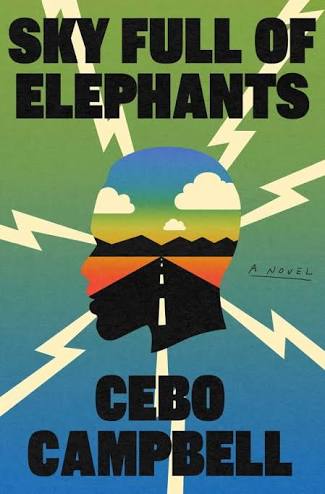
Finishing Sky Full of Elephants by Cebo Campbell left me in a strange, buzzing limbo — the kind where you close the book and just sit there, blinking, trying to figure out what exactly you’ve just experienced. Hours later, I’m still turning Campbell’s premise over in my mind, still deciding how I feel about the world he built and the argument he’s making. As a Black woman actively working through my own history with racism and the “marvelous condition of being black,” I couldn’t help but read this book with both my heart and my guard up. And honestly? I’m still not sure where I land. But here’s where the journey took me.
This Book Stayed With Me
Emotionally, Campbell had me in a chokehold. Recognition hit first — I saw Sydney immediately, because at some point in my life, she was me. Then came discomfort, the kind that makes you shift in your seat because the idea being presented doesn’t sit quite right in your spirit. But there was warmth too, in the way Campbell paints Blackness with such clarity and affection that I could almost see the scenes unfolding in my own living room. And tension — real tension — as Charlie approached his choice and I realized I was wrestling with the same question he was: Is this really the way to seek retribution for my people?
By the time relief arrived, I was grateful it was Charlie and not me who had to press that button. And grateful for the loophole he found. This book lingers. It forces reflection. It makes you sit with yourself.
Campbell’s Voice Is Unmistakable
One thing about Campbell: he writes like a man who knows exactly what he’s trying to say. His voice shows up most clearly in characters like Vivian and Hosea — people who believe something so deeply that they bend the air around them. Sydney, by contrast, is all shaky confidence and internal longing, trying to convince herself she’s more solid than she feels. Charlie wavers until he doesn’t, until one encounter snaps everything into place and his voice finally rings with the same certainty as the others.
If the book’s central idea is about harnessing Black consciousness for collective transformation, then its secondary theme is the quiet, powerful act of stepping fully into one’s own internal well of confidence. Campbell writes that tension beautifully.
The Ideas Are Big — And Sometimes Bigger Than the Page
My copy of this book looks like it survived a storm — scribbles everywhere, questions, rebuttals, affirmations. Campbell made me think, and not in a gentle way. I found myself pausing often, sometimes nodding, sometimes frowning, sometimes whispering “hold up now” to no one in particular.
The moment I realized the book wasn’t just about restoring Black consciousness but also about imagining what we could accomplish if we tapped into that shared frequency — that was a breath of fresh air. It reminded me of moments of collective Black joy that feel almost supernatural. Like my best friend’s wedding reception in 2024, when the DJ transitioned from Waka Flocka to the slow‑burn horns of “Swag Surfin’,” and suddenly the entire dance floor became one organism. Arms linked. Bodies rocking. Time suspended. That feeling — that unity — is the closest thing I’ve ever felt to the frequency Campbell describes.
And yet, even with all that wonder, I found myself wanting more. The book asks, “In a world without white people, what does it mean to be Black?” But when Charlie reflects on how unprepared America was after the event, I balked. My margin note on page seven reads, “What? With all these magical and talented niggas walking the earth? Ain’t no way.” Because truly — ain’t no way. I refuse to believe we wouldn’t have been ready to hold, repair, and reimagine the systems we’ve been forced to navigate for generations. That part felt dismissive of our brilliance.
A Beautiful Ending, But a Split Focus
Structurally, the book felt torn between two stories: a young woman coming of age in a world she barely recognizes, and a speculative exploration of Black potential unleashed. Both are compelling. Both deserved space. But together, they sometimes competed for attention.
Half the book is spent journeying toward the reimagined Alabama city — which, once revealed, is stunning and deeply satisfying. But Sydney and Charlie end up in different emotional and physical places by the end, and I found myself wishing their arcs converged more intentionally, especially given their shared history and the consciousness‑shifting festival that should have bound them.
Still, the final image — a city under the stars, powered by unity, love, and a frequency only we can access — is breathtaking. It made me wonder what a two‑part story could have done with all this potential.
 Relatable Rhythms