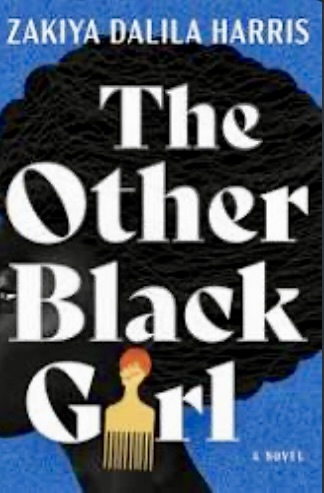
Zakiya Dalila Harris didn’t just write a thriller. She wrote a mirror — one I wasn’t prepared to look into as deeply as I did.
When I first met Nella, I was annoyed. She felt mousy, passive, too willing to shrink herself to fit into Wagner’s white publishing world. But somewhere around Chapter 6, when she spiraled into her relationship with her hair, something cracked open. Suddenly I wasn’t just reading Nella. I was reading me.
Her reflections on growing up Black in a white environment, on trying to honor the Blackness her parents instilled while navigating spaces that didn’t care about it — that was my story. Her longing to have been taught the “Blacktivities,” her desire to belong to Black spaces she didn’t grow up in, her dreams of writing, her complicated relationship with her own hair… I saw myself so clearly that I felt my toes get stepped on. And that’s when the book stopped being entertainment and became something else entirely.
The Violence of Being “The Only One”
Nella’s opinions about Colin Franklin’s book gutted me. The way she was dismissed, minimized, and then strategically overshadowed by Hazel — it was too familiar. Hazel’s arrival wasn’t just competition; it was a threat wrapped in locs and charm. From the moment she stepped on the page, I didn’t trust her. And I was right not to.
But what made it hard wasn’t Hazel’s behavior — it was Nella’s reaction to it. Her passivity. Her desire to play the game. Her fear of rocking the boat. I kept asking myself: Would I have done anything differently at her age? And the uncomfortable answer was probably not.
There’s a particular exhaustion that comes with being the only Black woman in a white space. You learn to pick your battles. You learn to swallow your brilliance. You learn to code-switch so seamlessly that you forget you’re doing it. And then someone like Hazel shows up — bold, unbothered, magnetic — and suddenly you’re questioning everything you’ve ever done to survive. That comparison is a violence all its own.
Hazel, Gaslighting, and the Quiet Horror of Being Undermined
Hazel’s manipulation is subtle at first — the kind of thing you could excuse away if you wanted to. But I didn’t want to. I felt the shift in her tone. The way she changed details only Nella would notice. The way she played dumb. The way she weaponized code-switching as a joke. Hazel wasn’t just gaslighting Nella. She was gaslighting me as a reader.
And the worst part? Nella kept doubting herself. Kept shrinking. Kept hoping Hazel would follow the unspoken rules of Black sisterhood. But Hazel wasn’t playing that game. She was playing a different one entirely — one where success meant being the only Black girl, not the best one. That hit hard.
The Coalition: A Terrifyingly Plausible Idea
When the concept of the OBGs — a coalition of Black women willing to sabotage other Black women for success — emerged, I laughed. Not because it was funny, but because it was possible. Harris tapped into something real: the way scarcity, racism, and generational trauma can twist ambition into something monstrous. The idea that white institutions wouldn’t even notice the internal warfare? That part felt too true.
And then the twist: the pomade. The formula. The literal chemical manipulation of Black women’s minds and identities. It was absurd and yet… not. Black hair has always been political. Always been a site of control, pride, rebellion, and vulnerability. Of course the horror would live there. Of course the violation would happen through our scalps.
Watching Nella Unravel
By the time Nella blurts out “You people are unfuckingbelievable” in the meeting, I felt like I was watching a slow-motion car crash. She was unraveling in real time — the same unraveling that happened to Kendra decades earlier. The same unraveling that happens when a Black woman finally hits her limit. And still, she didn’t tell her boyfriend. Didn’t tell her best friend until too late. Didn’t call the number. Didn’t trust her instincts.
I wanted to shake her. But I also understood her. When you’ve spent your whole life trying to be agreeable, trying to be palatable, trying to be the “good Black girl,” it’s hard to suddenly become the one who blows up the spot. Even when you should.
The Past, the Present, and the Price of Survival
The chapters from Kendra and Diana’s perspectives were devastating. The betrayal. The jealousy. The way white institutions reward compliance and punish authenticity. The way Black women are forced to choose between survival and selfhood.
Diana’s justification — that she was helping Black women “navigate racism more easily” — was chilling. Because it echoed real conversations. Real compromises. Real temptations.
What is the cost of success in a world not built for you?
What are you willing to lose?
And who are you willing to become?
Hair, Sisterhood, and the Final Violation
The natural hair party scene was brilliant and horrifying. The intimacy of Black women doing hair together — the trust, the nostalgia, the sacredness — made the betrayal feel personal. Of course Nella let her guard down. Of course she closed her eyes. Of course she didn’t expect danger to come through something so familiar and beautiful. That’s what made it hurt. Thank God for her best friend; because Nella was seconds away from losing herself completely.
In the End, the Book Isn’t Just About Publishing
It’s about identity.
It’s about survival.
It’s about the cost of assimilation.
It’s about the quiet terror of being the only Black girl in the room — and the even greater terror of realizing you’re not.
Reading The Other Black Girl felt like watching a version of myself walk into a trap I’ve spent my whole life trying to avoid. It was uncomfortable, infuriating, validating, and deeply familiar.
And that’s why it worked.
 Relatable Rhythms